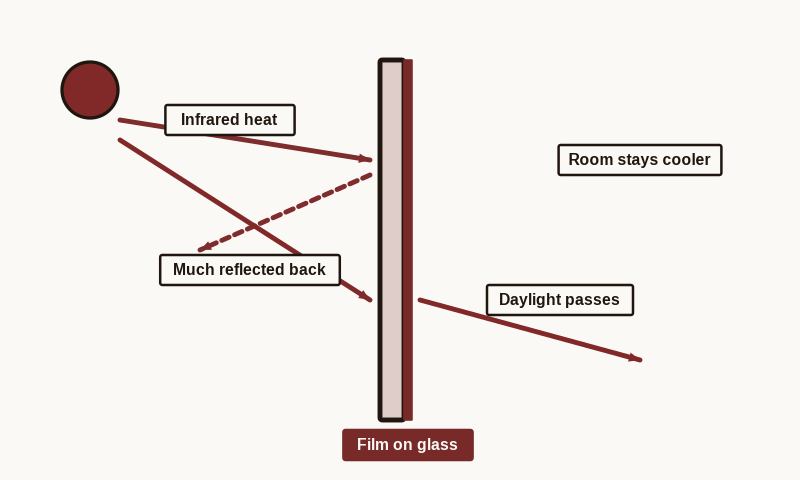
Yes, window tint reduces heat, as long as it is a film designed for heat control and the window gets direct sun. A solar control, ceramic or reflective film rejects part of the sun's energy at the glass, so less of it warms the room. A purely decorative or dark dyed film does much less. If you are choosing a film, our main page on heat control window film compares the types; this guide explains the "how" and "how much" in plain words.
How does window tint reduce heat?
Sunlight carries energy as visible light, invisible infrared and a little ultraviolet. When it passes through glass and hits floors and furniture, that energy turns into heat inside the room. Heat control film stops part of it at the glass, either by reflecting it back outside or absorbing it and shedding much of it to the outside air.
The International Window Film Association describes film as lowering solar heat gain by reflecting, absorbing or transmitting solar energy. Different films do this differently:
- Reflective films bounce a large share of solar energy away.
- Ceramic and spectrally selective films target infrared, the heat you feel, while letting visible light through.
- Dyed films mostly absorb light and darken the glass, which rejects less heat for their darkness.
How much does window tint reduce heat?
It depends on the film, the window and the sun on it, so there is no single honest figure. A good heat control film can cut the solar heat coming through a sunny window substantially. The IWFA lists film type, installation quality, window orientation and local climate as the factors that decide the result.
What that means in practice:
| Window | Difference you are likely to notice |
|---|---|
| West-facing, unshaded, single-pane | Large: the room stays usable in the afternoon |
| South-facing, unshaded | Noticeable, especially in late summer |
| East-facing | Noticeable in the morning |
| North-facing or shaded | Small |
| Already low-e double-pane | Smaller, since the glass already cuts some heat |
To compare films, look at total solar energy rejected (higher is cooler) or the solar heat gain coefficient (lower is cooler) on each product's spec sheet.
What type of tint is best for house heat?
For most homes, a ceramic or spectrally selective film is the best balance: high heat rejection with light, natural-looking glass. If a mirrored look is fine, a reflective film often rejects the most heat for the money. Dark dyed films are the weakest choice for heat, because darkness is not the same as heat rejection.
See ceramic window film and reflective window film for the two main options.
Does a darker tint keep more heat out?
Not necessarily. Darkness measures visible light, while most of the heat you feel comes from infrared. A dark dyed film can let a lot of infrared through, while a light ceramic film can block much of it. Choose by the heat rejection figure, then pick the darkness you like for glare and looks.
Will tinting windows lower my cooling bill?
It can lower cooling costs in rooms with a lot of sun on the glass. The IWFA, citing Energy Star, says film may save 20% to 40% on energy costs during the cooling season, but treat that as a best case for very sunny glass. Shaded homes save much less. We explain how to judge it on window film energy savings.
Why does window tint matter more in Oklahoma City?
Because the summer is long, hot and sunny. Oklahoma City reaches 90°F on close to 70 days a year on average and gets about 69% of possible sunshine, so west and south glass soaks up heat for months. Rooms with big unshaded windows are where film makes the clearest difference here.
The same sunshine drives UV fading of floors and furniture, which film also slows; see UV blocking window film.
When does window tint barely help with heat?
Film helps little on windows that get no direct sun, such as north-facing or deeply shaded glass, and less on windows that already have a good low-e coating. It also can't fix heat that comes from a hot attic, poor insulation or air leaks. If the whole house is hot, not just sunny rooms, look at those first.
Our guide to window film on low-e glass covers what happens when the glass already has a coating.
Does window tint reduce heat in winter too?
Most heat control film is designed for summer and blocks some welcome winter sun as well. Insulating low-e films are different: they also reduce heat escaping through the glass on cold nights. If winter comfort matters too, ask for a film with published winter performance. See window film for winter.
Questions people ask
What can I put on my house windows to keep the heat out?
Heat control or ceramic window film on the glass is the most common answer that keeps the view. Exterior solar screens block even more heat but change the look. Blinds and curtains help when closed. The costs of each are compared on cost to block heat through windows.
Do solar control window films work?
Yes. Solar control films reduce the solar heat coming through sunny glass, with the biggest effect on west and south windows. How well depends on the product and the glass, so compare total solar energy rejected and get the installer to confirm the film suits your windows.
Does window film keep the sun out completely?
No. Film lets daylight through, which is the point: you keep the view and the light. It reduces the heat, glare and UV that come with the sun. Some films block a high share of UV, but none blocks all sunlight unless it is opaque.
Is window film better than blinds for heat?
Film stops heat at the glass and works all day without anyone adjusting it, while interior blinds catch heat after it has passed through the glass. Closed blinds also block the view. Many homes use both: film for all-day protection, blinds for extra shade on the hottest afternoons.
How quickly will I notice the difference after tinting?
Usually the same day. On a sunny afternoon you can feel less heat near the glass and see less glare as soon as the film is on, even while it is still curing. The full appearance settles over the following weeks as any water pockets dry out.
This guide is one of many on Oklahoma City window tinting.
Sources
Last changed