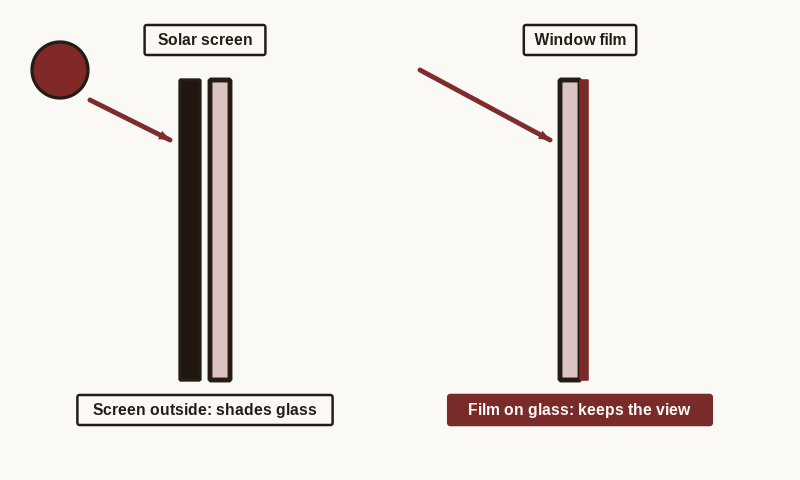
Solar screens block heat before it reaches the glass, which makes them very effective, but they change how the house looks and dim and screen the view. Window film works at the glass, keeps the view clear and the house looking unchanged, and needs no seasonal handling, but stops a little less heat than a dense exterior screen. Both cost roughly the same per typical window. This guide compares them so you can choose for each window. For film types in detail, see heat control window film.
How do solar screens and window film block heat differently?
A solar screen is a dense mesh fitted on the outside of the window that shades the glass, stopping much of the sun's energy before it reaches the pane. Window film is applied to the glass and rejects heat by reflecting or absorbing solar energy at the glass. Stopping heat outside is inherently efficient, which is the screen's main advantage.
How do solar screens and window film compare side by side?
Solar screens win on raw heat blocking because they shade the glass from outside. Window film wins on the view, the look of the house, protection from weather and year-round convenience. Cost per typical window is similar. The table sets out each point so you can weigh what matters most for a particular window.
| Solar screens | Window film | |
|---|---|---|
| Where it goes | Outside the window | On the glass, usually inside |
| Heat blocking | Very effective, shades the glass | Effective, depends on film |
| View from inside | Dimmer, seen through mesh | Clear; slightly tinted or mirrored with some films |
| Look from outside | Changes the house's appearance | Little change with light films |
| Daylight | Noticeably reduced | Light films keep most daylight |
| Weather and hail | Exposed; mesh can be damaged | Protected indoors |
| Upkeep | Cleaning, removing for winter sun if wanted | Gentle cleaning |
| Guide cost | about $100 to $250 per typical window | about $5 to $15 per sq ft installed |
Cost figures from published guides checked in November 2026. A typical 15 square foot window works out similar either way.
Which blocks more heat, solar screens or film?
A dense solar screen usually blocks more heat than most films, because it shades the glass from outside. High-performance reflective and ceramic films come close on many windows. The difference matters most on unshaded west windows; on south and east windows, a good film is often enough, with a clearer view.
The IWFA notes that film results depend on film type, installation, orientation and climate, and the same is true of screens.
Which is better for the view and the look of the house?
Window film. Light films leave the view almost unchanged and the outside of the house looking as it did. Solar screens put a visible dark mesh over the window, dim the view and change curb appeal, which some HOAs restrict. Where the view or the look matters, film is usually the better choice.
Which lasts longer in Oklahoma weather?
Film installed indoors is protected from weather, so it typically lasts 10 years or more. Solar screens are exposed to sun, wind and hail, and the mesh or frames can be damaged in storms. Screens can be repaired or rescreened, though. In hail-prone weather, interior film avoids that exposure.
When are solar screens the better choice?
Solar screens suit west-facing windows you don't look out of much, rental properties where the owner wants maximum heat cut, garages and workshops, and houses where the exterior look isn't a concern. They are also easy to remove for winter if you want the sun's warmth then.
When is window film the better choice?
Film suits windows you look out of, front elevations where looks matter, HOA neighborhoods with exterior restrictions, large picture windows and sliding doors, skylights, upper floors that are hard to reach from outside, and anywhere you also want privacy or safety. It also works all year with nothing to take down.
See ceramic window film and reflective window film.
Can you use solar screens and window film together?
Yes, though few homes need both on the same window. A common mix is film on front and view windows, and screens on a hard-hit west side nobody looks out of. Doubling up on one window adds cost and dims it further for limited extra benefit.
See cost to block heat through windows for a cost comparison of all the options.
Questions people ask
Are solar screens better than window tint?
For pure heat blocking, a dense solar screen often wins, because it shades the glass outside. For view, appearance, durability against weather and year-round use, window film usually wins. Many homes choose by window: film where you look out, screens where you don't.
Do solar screens make a house dark?
They reduce daylight noticeably and put a mesh over the view, so rooms feel dimmer. Lighter-density screens reduce this but block less heat. Light window films keep much more daylight while still cutting heat, which is why many people prefer film on living-area windows.
What is the best solar screen for windows?
The best solar screen balances shade and view for that window: higher-density screens block more heat but darken more. For windows you look out of, many people prefer a ceramic or solar window film instead, which keeps the view clear.
Do solar screens work in winter?
They block winter sun too, which can make rooms cooler on sunny winter days. Many owners remove them in winter to let the sun warm south rooms. Most window films stay on year-round; insulating films also reduce heat loss in winter.
Which is cheaper, solar screens or window film?
For a typical window they cost about the same: roughly $100 to $250 for a solar screen and roughly $75 to $225 for film at about $5 to $15 per square foot on a 15 square foot window. Large windows and doors often favor film; standard windows are close.
The rest of our guides start from window tinting in Oklahoma City.
Sources
- Published solar screen cost guides (Angi, HomeGuide, HomeAdvisor), checked November 2026
- Published window film cost guides (HomeAdvisor, Angi, HomeGuide), checked November 2026
- International Window Film Association, heat control
Last changed