Window film can lower cooling costs by cutting the solar heat that comes through sunny glass, but the saving varies widely from house to house. The International Window Film Association, citing Energy Star, says film may save 20% to 40% on energy costs during the cooling season, which is a best case for buildings with a lot of unshaded glass. A shaded house with small windows will save far less. This guide explains what drives the number, how to estimate your own, and what film can't fix. For the film types themselves, see heat control window film.
Does window film really save energy?
Yes, on glass that takes direct sun. Film reduces solar heat gain, so the air conditioning removes less heat from those rooms. The IWFA says film can often pay back its installation cost in a few years in commercial buildings with large glass areas. Homes see smaller, more variable savings, and comfort is often the bigger benefit.
Some films also lower the glass's emissivity, which the IWFA says can add winter savings by reducing heat loss, not just summer ones.
Why do savings vary so much between homes?
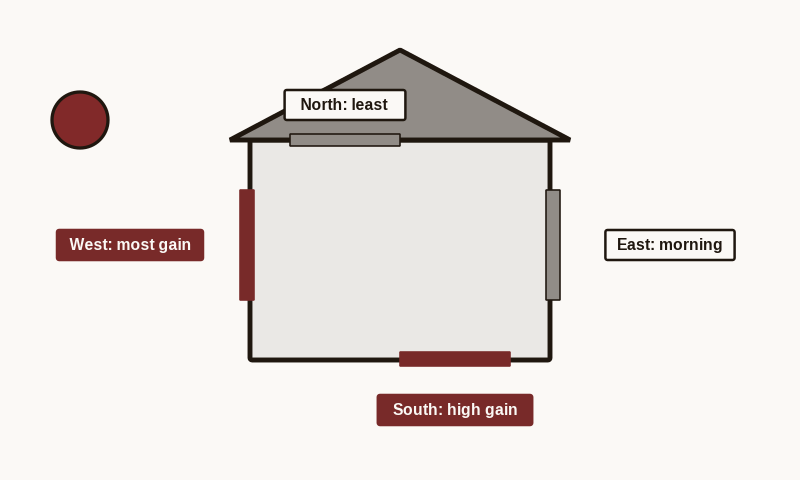
Because the share of your cooling load coming through windows varies. A house with big west and south windows and no shade gains a lot of heat through glass, so film makes a big dent. A house with small, shaded windows gains most of its heat through the roof and walls, so film changes less. The IWFA lists orientation, film type, installation and climate as the factors.
| Factor | Bigger savings | Smaller savings |
|---|---|---|
| Window direction | West and south | North |
| Shade | None | Trees, porches, awnings |
| Glass area | Large picture windows, sliding doors | Small windows |
| Existing glass | Single-pane, clear | Low-e double-pane |
| Climate | Long, hot, sunny summers | Mild summers |
How can I estimate my own savings?
Look at where your heat comes from first. If the hottest rooms are the ones with large sunny windows, film is likely to help noticeably. If the whole house is hot, including rooms with little glass, the attic, insulation or air leaks are the bigger problem. An installer can give performance figures for your glass to compare.
A practical way to judge it:
- Find the problem rooms. Which rooms are hot on summer afternoons, and do they face west or south?
- Measure the glass. Note the square footage of sunny glass in those rooms.
- Check the glass. Single-pane or double-pane, and any existing low-e coating.
- Compare films. Ask for total solar energy rejected on your glass for each option.
- Weigh comfort too. A room you can use in the afternoon has value even if the bill drops only a little.
The IWFA also refers people to its Efilm analysis tool, which it says is built on the U.S. Department of Energy's EnergyPlus platform, for building-level estimates.
Is Oklahoma City a good place for window film savings?
Yes, more than many places. Oklahoma City reaches 90°F on close to 70 days a year on average, sees about 10 days at 100°F or more, and gets around 69% of possible sunshine. Long, hot, sunny summers mean a lot of solar heat through west and south glass for months, which is where film pays off most.
Winter here is short and mild by comparison, so most homes put cooling first when choosing film.
Which film saves the most energy?
The film that rejects the most solar energy on your glass saves the most in summer, which is usually a reflective film, followed closely by high-performance ceramic or spectrally selective films. If winter heating matters too, an insulating low-e film adds savings in cold months. Compare total solar energy rejected and, for winter, U-value.
See reflective window film, ceramic window film and window film for winter.
What can't window film fix?
Film can't fix heat coming through a hot attic, thin wall insulation, leaky ducts or drafts around frames. It also does little on north-facing or shaded windows. If your cooling bill is high across the whole house, an energy audit of the attic, insulation and ducts may find bigger savings first, with film for the sunny rooms.
Is window film cheaper than replacing windows to save energy?
Much cheaper. Replacing windows with new low-e units costs many times more than filming the existing glass. New windows also fix drafts and failed seals, which film can't. If the frames and seals are sound and solar heat is the problem, film gives much of the cooling benefit at a fraction of the price.
The cost comparison is on cost to block heat through windows.
Questions people ask
How much can window film lower my electric bill?
It varies widely. The IWFA, citing Energy Star, says film may save 20% to 40% on cooling-season energy costs in favorable cases. Homes with lots of unshaded west and south glass save the most; shaded homes save much less. Ask for performance figures on your glass to judge it.
How long does window film take to pay for itself?
The IWFA says film can often pay back in a few years on commercial buildings with large sunny glass areas. For homes, payback depends on glass area, direction and cooling costs, and may be longer. Many homeowners value the comfort and fade protection as much as the savings.
Does window film save energy in winter?
Standard solar film saves little in winter and can block some welcome sun. Insulating low-e films reduce heat loss through the glass, which the IWFA says can add winter savings. If heating costs matter to you, ask for a film with a published winter U-value.
Are there rebates for window film?
Some utilities and programs have offered rebates for qualifying window film at times, but availability changes. Check with your electricity provider and any current federal or state programs before buying, and keep the film's performance data and receipt, since programs usually ask for them.
Is window film worth it just for energy savings?
Sometimes, on very sunny glass. On its own the energy saving may not justify film on every window. Combined with cooler rooms, less glare and slower fading, it usually does on west and south windows. On shaded windows, it rarely pays back on energy alone.
The rest of our guides start from Oklahoma City window tinting.
Sources
Last changed