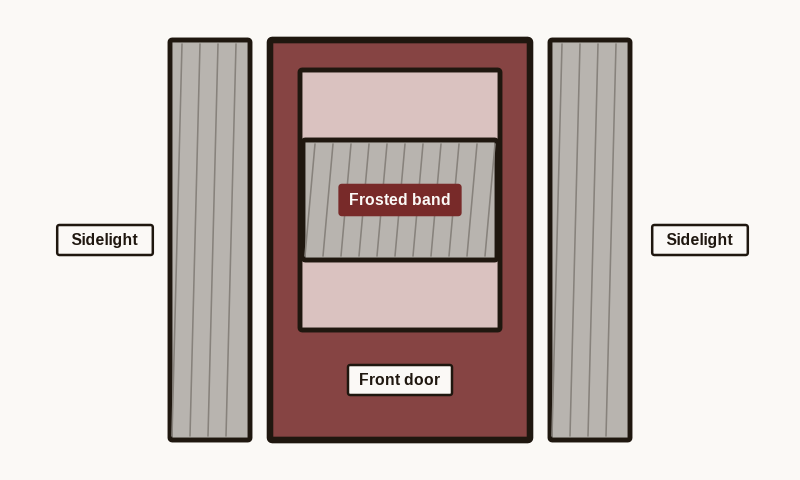
Glass door frosting means applying frosted or decorative film to the glass in a door, such as a front door and its sidelights, French doors, a pantry or office door, so people can't see through while light still passes. It is far cheaper than ordering frosted glass, it goes on in place, and it can be changed later. This guide covers the styles that suit different doors, practical points like trimming around grilles, and costs. For the full range of patterns and finishes, see decorative window film.
Why frost the glass in a door?
People frost door glass for privacy, to stop callers seeing straight into the hallway, to soften light, and to update the look of builder-grade glass. On interior doors, frosting adds privacy to a home office or bathroom without losing borrowed light. In offices, it marks glass so people don't walk into it.
Common door jobs:
- Front doors and sidelights: privacy at the entry, the most common job.
- French doors between rooms: privacy for a home office or guest room.
- Bathroom and laundry doors with glass panels.
- Pantry and cabinet doors: style rather than privacy.
- Office doors and glass walls: privacy and visibility markings.
What frosting styles suit a front door?
Plain frost is the safe, classic choice. Etched-glass and reeded or fluted looks feel more upscale and suit modern doors. Frosted bands or gradients keep some view at the top. Stained glass looks suit traditional homes with transoms or decorative sidelights. Choose a style that matches the door's age and the rest of the house.
| Style | Privacy | Look |
|---|---|---|
| Plain frost | High | Clean, classic |
| Etched or sandblasted look | High | Upscale, close to real etched glass |
| Reeded or fluted | High | Modern, textured |
| Band or gradient | Partial | Keeps a view at the top |
| Stained glass look | Medium | Traditional, colored |
For colored designs, see stained glass window film.
Does frosting a door darken the hallway?
Only slightly with a standard frost. Frosted film lets most daylight through and spreads it evenly, so a hallway lit by a glass front door usually stays bright. Dense or opaque films darken more. If the entry is already dim, choose a lighter frost or frost the lower half of the sidelights only.
Frosted film also gives privacy at night, unlike mirror film; see day and night privacy window film.
How is film fitted around door grilles and muntins?
Doors with built-in grilles between the glass are easy, because the film goes on the flat inner surface. Doors with grilles fixed on top of the glass, or many small divided panes, need each pane cut and fitted separately, which takes longer and costs more. Neat trimming at every edge is what makes a door look professionally done.
This Old House lists French doors at about $10 to $19 per square foot to tint, more than plain windows, because of this extra cutting.
Does frosted film make door glass safer?
Standard frosted film isn't a safety film, but it does make clear glass more visible, which helps prevent people walking into glass doors and walls. If you want glass that holds together when broken, choose a security or safety film, some of which come in frosted versions. Glass next to door locks benefits most.
See window security film.
Can I frost my front door glass myself?
Yes, on smooth, flat glass with few panes. Static cling frosted film is the easiest DIY option and peels off if you make a mistake. Doors with many small panes, decorative textured glass or a door you see every day often look better with professional adhesive film. Textured glass usually won't hold film on its textured side.
See static cling window privacy film and DIY window tinting vs hiring an installer.
How much does it cost to frost a glass door?
Frosted film costs about $6 to $10 per square foot installed and decorative film about $6 to $13, according to published guides. A front door with sidelights, roughly 25 square feet of glass, often comes in around an installer's minimum charge. French doors with many panes cost more because of the cutting.
See decorative window film cost and frosted glass vs film.
Questions people ask
How can I make my front door glass private?
Apply frosted or decorative film to the inside of the door glass and sidelights. It blocks the view in both directions day and night while letting light through. If you want to keep some view, use a frosted band or a gradient. Mirror film isn't ideal, since it fails at night.
Can you frost textured or decorative door glass?
Usually only on a smooth side. Film needs a flat surface to bond, so if the decorative texture is on the outside and the inside is smooth, film can go on the inside. Fully textured or beveled glass is hard to film neatly.
Will frosted film on a door peel over time?
Quality adhesive film fitted well on smooth glass rarely peels for many years. Doors that get slammed, direct hot sun or harsh cleaning can lift edges sooner, as can static cling film. Neat trimming and gentle cleaning help it last.
Can I frost only half of a glass door?
Yes. Frosting the lower half, or a band at eye level, is common on front doors, sidelights and bathroom doors. It blocks the line of sight while keeping light and a view of the sky above, and a straight, level edge makes it look intentional.
Is frosting a door cheaper than replacing the glass?
Much cheaper. Guides put replacement frosted or etched glass at roughly $25 to $100 per square foot installed, against about $6 to $10 for frosted film. Film also goes on in place in an hour or two, with no need to remove the door.
The rest of our guides start from Paneshade.
Sources
- Published decorative and frosted film cost guides (HomeAdvisor, Angi, This Old House), checked November 2026
Last changed