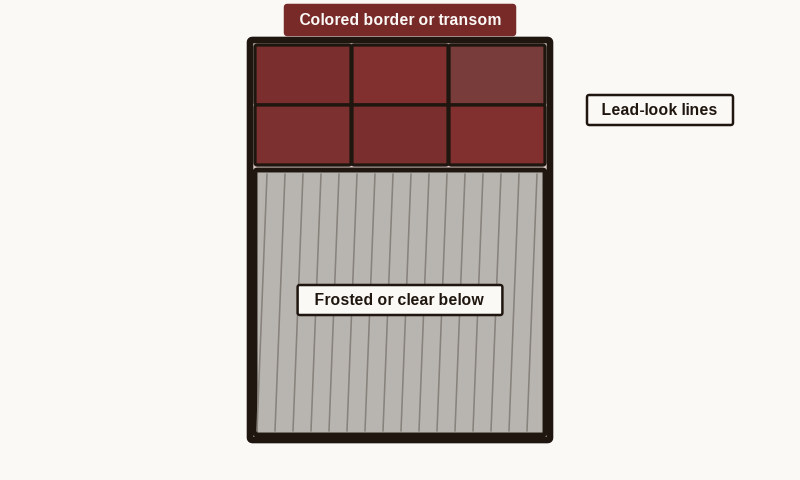
Stained glass window film is a printed or layered film that gives plain glass the look of colored, leaded stained glass. It adds color and pattern, and most designs also give privacy by obscuring the view through the glass. It costs a fraction of real stained glass and can be removed later. This guide covers where it suits a home, how it handles privacy and sun, peel-and-stick versus installed film, and how it compares with the real thing. For privacy options more broadly, see privacy window film.
What is stained glass window film?
It is a translucent film printed with colored glass designs, often with dark lines imitating the lead came that holds real stained glass pieces together. Light coming through takes on the colors, much like the real thing. Some films add texture to mimic the uneven surface of handmade glass.
Designs range from traditional Victorian and Craftsman patterns to geometric and modern abstract styles, so it can suit both older and newer homes.
Where does stained glass film suit a house?
It suits small feature windows where color adds character: transoms above doors, sidelights, stair landing windows, bathroom windows, and small accent windows. It works less well on large picture windows, where the view matters and a big expanse of color can overwhelm a room.
Good places:
- Transoms and sidelights around a front door.
- Bathroom windows, for privacy with color.
- Stairwell and landing windows that catch afternoon light.
- Interior door panels and cabinet doors.
Older Oklahoma City neighborhoods with early 1900s houses, such as Heritage Hills, are where traditional patterns tend to look most at home; see our Heritage Hills page.
Does stained glass film give privacy?
Most designs give good privacy, day and night, because the colored patterns and textures obscure the view. Lighter or partly clear designs give less. If privacy is the main goal, choose a denser pattern or one with a frosted background between the colored sections, and check a sample from outside at night.
For plain privacy without color, frosted window film is simpler.
Will stained glass film fade in the sun?
Printed colors can fade over time in strong direct sun, especially on west and south windows in hot climates like Oklahoma's. Quality films use more fade-resistant inks and often block UV to protect the room, but expect color change sooner on hard-hit glass than on a shaded transom. Check what the warranty says about color.
Is peel-and-stick stained glass film any good?
Peel-and-stick and static cling stained glass films are widely sold for DIY and suit small, simple windows and renters. They are cheaper and easy to remove, but often thinner, with less fade resistance and a less convincing look than higher-grade decorative films. For a front door you see every day, a better film fitted carefully looks far more convincing.
See static cling window privacy film and DIY window tinting vs hiring an installer.
How does stained glass film compare with real stained glass?
Real stained glass, made from colored glass pieces joined with lead, is a craft object: richer in depth, very long-lasting, and expensive. Film imitates the look at a small fraction of the price, can be removed or changed, and doesn't need a new window. Up close and in strong light, real glass has more depth and sparkle.
| Stained glass film | Real stained glass | |
|---|---|---|
| Cost | Low, priced per square foot | High, often custom-made |
| Installation | On existing glass | Replaces or adds a panel |
| Look up close | Convincing at a distance | Richer, more depth |
| Lifespan | Years; colors may fade | Decades with care |
| Removable | Yes | No |
How much does stained glass window film cost?
Published guides put installed decorative film at about $6 to $13 per square foot, with premium and custom designs costing more. A small transom or bathroom window usually costs an installer's minimum charge, often around $250, so combining several windows in one visit is better value. DIY film costs much less in materials.
See decorative window film cost and decorative window film.
Questions people ask
Does stained glass window film look real?
Good stained glass film looks convincing at normal viewing distance, especially with light shining through it. Up close, or in very strong side light, real glass shows more depth. Quality printing, textured finishes and neat edges make the biggest difference.
Can stained glass film go on a front door?
Yes, on smooth door glass, transoms and sidelights. It adds color and privacy at the entry. Choose a design that suits the age and style of the house, and consider professional fitting on a door you see every day, where edges and alignment show most.
Is stained glass film removable?
Yes. Static cling versions peel straight off. Adhesive stained glass film comes off with gentle heat and a plastic scraper, followed by cleaning off any adhesive. Newer film comes off more easily than old, sun-baked film. See window film removal for the steps.
Does stained glass film block UV?
Many decorative films block a high share of UV, which protects floors and furniture and can help the film's own colors last. The figure varies by product, so check the stated UV rejection if it matters to you, especially on sunny glass.
Can I use stained glass film on a large window?
You can, but large areas of color can darken a room and overwhelm the space, and fitting one big piece without bubbles is hard for DIY. A common approach is a stained glass border or upper band, with clear or frosted glass in the main area.
The rest of our guides start from Paneshade.
Sources
- Published decorative film cost guides (HomeAdvisor, Angi, American Window Film), checked November 2026
Last changed