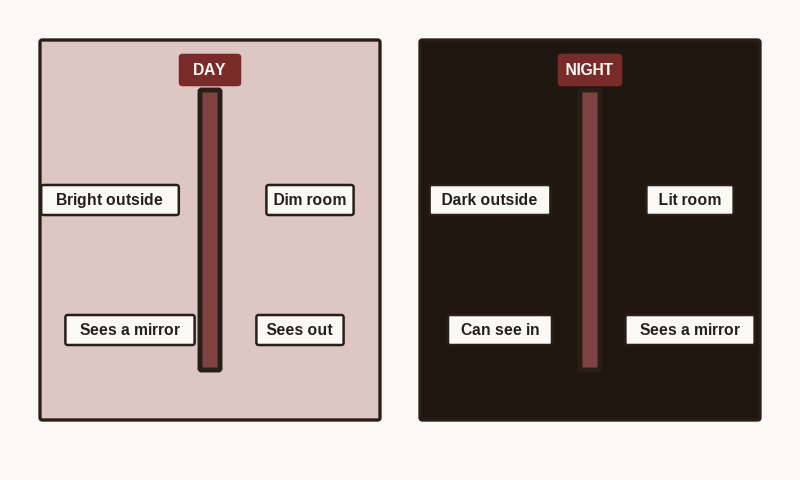
One-way mirror film is a reflective window film that lets you see out while people outside see a mirror, as long as it is brighter outside than inside. It is the only film that keeps your view and hides the room in daylight, which makes it popular for street-facing living rooms and ground-floor offices. It stops working at night when your lights are on. This guide explains why, how to choose the strength, and where it fits. For all privacy options side by side, see privacy window film.
How does one-way mirror film work?
The film has a thin reflective layer that reflects part of the light hitting it from either side and lets the rest through. The brighter side sees mostly reflection; the darker side sees mostly through. In daylight the street is far brighter than your living room, so passers-by see their reflection and you see out.
It isn't truly one-way. If you turn the room lights on at dusk, the room becomes the bright side and the effect reverses. That is the same principle as an interview-room mirror, which only works because the observation room is kept dark.
Can people see in at night with one-way film?
Yes, once it is darker outside than inside with your lights on. At night the film reflects the room back at you and lets people outside see in. For evenings you need blinds or curtains, or a different film where night privacy matters, such as frosted film. There is no clear film that gives full night privacy.
Our guide to day and night privacy window film covers the options that work after dark.
How dark should one-way mirror film be?
Stronger, darker mirror films give more daytime privacy, even when the light difference is small, but they make the view darker and the room dimmer. Lighter mirror films keep more daylight and view but need a bigger brightness difference to work. Most homes choose a medium film for living areas and darker films for glare-heavy or very exposed glass.
| Film strength | Daytime privacy | View from inside | Room brightness |
|---|---|---|---|
| Light reflective | Good on bright days | Clear | Little change |
| Medium reflective | Strong | Slightly darker | Noticeably dimmer |
| Dark or dual-reflective | Very strong | Darker | Much dimmer |
Ask to see samples on your actual window at the time of day you care about.
Where does one-way mirror film work well?
It works well on glass where you want the view and daytime privacy together: street-facing living rooms, front rooms close to the sidewalk, ground-floor home offices, and offices or clinics facing a parking lot. It also cuts heat and glare, which suits west-facing glass in Oklahoma's long summers.
Poorer fits are bathrooms and bedrooms where you need privacy at night, and historic or HOA homes where a mirrored look isn't allowed.
Does one-way film also block heat?
Yes. One-way mirror film is a type of reflective film, and reflective films are among the strongest at rejecting solar heat and glare. That double benefit is why people often choose it for sunny street-facing rooms. Heat rejection varies by product, so compare the total solar energy rejected figure.
See reflective window film for the heat side and heat control window film for comparing films.
What are the downsides of one-way mirror film?
The main downsides are no privacy at night, a darker view and room, a mirrored look from outside that some neighbors or HOAs dislike, and possible signal weakening from metallized films. Some heavy reflective films also need care on certain double-pane or low-e glass. Knowing these up front avoids most disappointment.
On double-pane or low-e glass, the installer checks the film maker's guidance first; see tinting double pane windows.
Can I install one-way film myself?
Yes, on small, flat windows. Reflective film shows every speck of dust and bubble, more than clear film, so preparation is critical. Large panes and double-pane glass are better left to an installer. See DIY window tinting vs hiring an installer.
For costs, see home window tinting cost.
Questions people ask
What can I put on my windows so I can see out but no one can see in?
One-way mirror (reflective) film is the answer in daylight: you see out, people outside see a mirror. It only works while it is brighter outside than in, so at night with lights on people can see in. Add blinds for evenings, or use frosted film where you need privacy around the clock.
Is there a one-way film that works at night?
No clear or mirrored film gives full privacy at night with your lights on. Darker dual-reflective films reduce how much can be seen, but the physics doesn't change. For night privacy, use frosted or decorative film, or close blinds after dark.
Does one-way mirror film work on cloudy days?
Usually, as long as it is still brighter outside than in the room. On very overcast days with room lights on, the effect weakens. Darker films keep working better in low light, at the cost of a dimmer room. Turning lights off near the window helps.
Can neighbors see in during the day with mirror film?
Mostly not. With the outside brighter than your room, they see a reflection. Close up, with hands cupped against the glass, someone may see shapes, and a brightly lit lamp near the window can show through. Keep strong lights away from the glass in the daytime.
Does mirror film look strange from outside?
It looks like mirrored or reflective glass in daylight, which some people like and some don't. On some houses it can look out of place next to clear windows, so many people apply it to a whole elevation for a consistent look. Check HOA rules before choosing it for the street side.
For the wider picture, start with window tinting oklahoma city.
Sources
Last changed